
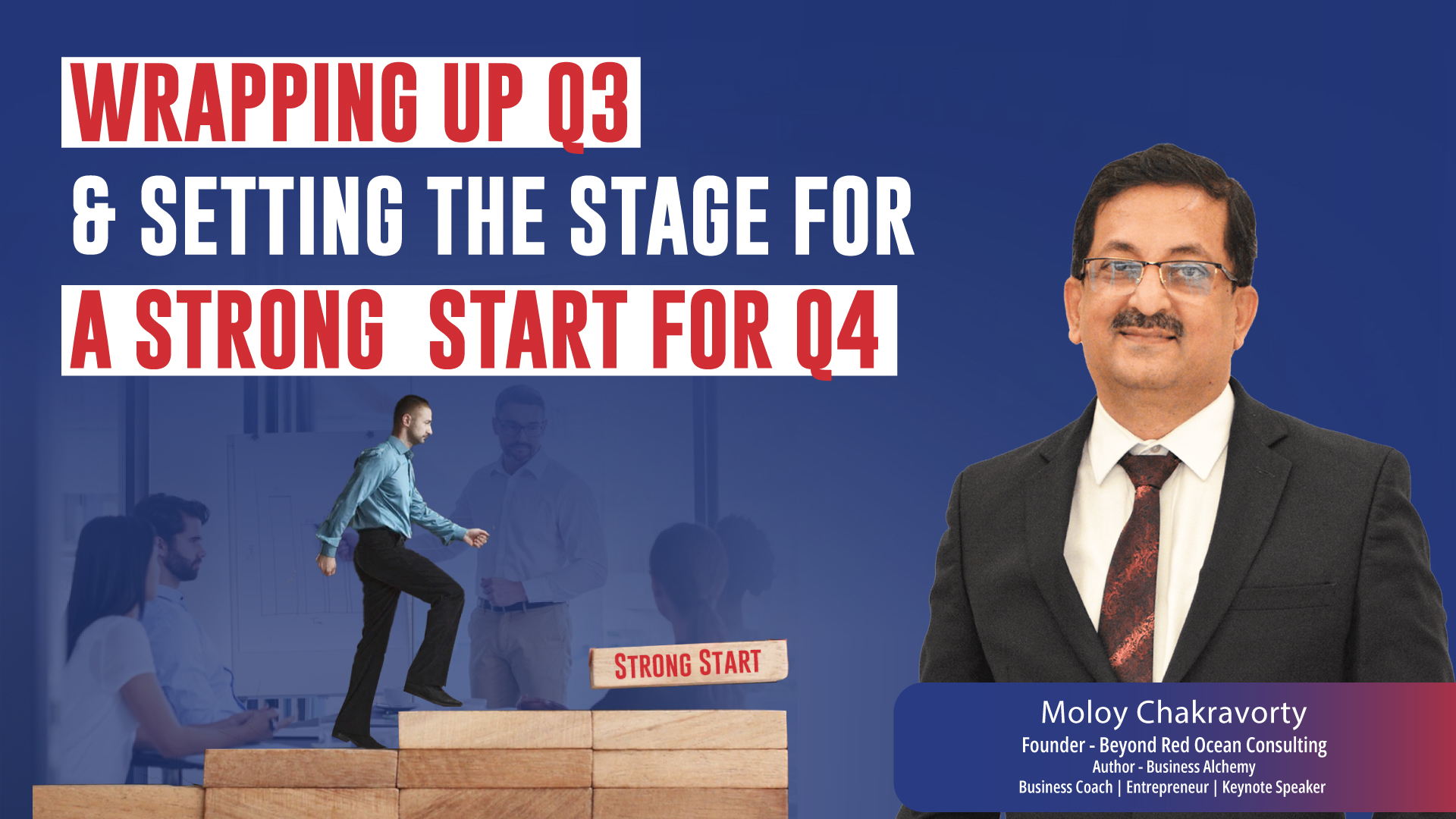
Wrapping Up Q3 & Setting The Stage For A Strong Start For Q4
For most MSMEs, 2025 didn’t go the way we hoped. You didn’t need news reports or industry data to tell you that. The signals were right inside your own premises — in rising raw material bills, in the tightening margins, in customers stretching payments, and in that constant struggle to hold on to skilled workers who were themselves facing a cost-of-living squeeze.
Business kept moving, yes, but very few MSME owners would say it moved comfortably. The common sentiment across factories, workshops, job shops, fabrication units, and small engineering firms was almost identical: “We’re working harder, but we’re not feeling stronger.”
And that sets up the real question we need to ask ourselves now:
How do we enter 2026 in a better position than the one we carried through 2025?
Not with theory. Not with jargon.
But with practical clarity.
What 2025 Really Taught MSMEs
If there’s one lesson 2025 reinforced, it’s that costs have a mind of their own. Even if you never imported a single component, you felt the heat because the ripple always reaches the MSME sector first. Metals became more expensive, chemical prices fluctuated wildly, packaging and spare parts were never stable long enough for you to plan comfortably.
As a result, every decision felt slightly more uncertain. Customers didn’t stop buying, but their behaviour changed. Instead of confirming orders with confidence, they negotiated more, delayed decisions, split quantities, asked for extended credit, and stretched payment cycles. Not because they wanted to trouble you, but because they were facing their own pressures. When the entire chain tightens, MSMEs get squeezed in the middle.
Cash flow, therefore, became the biggest stress point. Throughout the year, many MSMEs saw invoices being raised but not realised, sales review without profits increasing, and turnover improving while liquidity weakened. More than anything else, 2025 reminded us that survival in this segment is never about revenue — it’s always about cash.
Retaining skilled workers also became a daily challenge. Wage expectations went up, absenteeism increased, and many MSME owners spent a significant part of the year firefighting manpower issues instead of building the business.
If you reflect honestly, 2025 rewarded the MSMEs that stayed disciplined. The ones who monitored costs week by week, kept inventory light, stayed close to customers, and controlled their internal processes. Not the aggressive players, but the organised ones.
What 2026 Will Demand From MSMEs
The coming year won’t automatically become easier. But it can become far more manageable if MSMEs walk in with clarity, speed, and a few important mindset shifts.
The first shift is around cash flow. In 2026, the MSMEs who win will be the ones who treat cash as their daily dashboard, not a monthly surprise. When you track your cash every week, talk to your major customers about payment discipline upfront, negotiate slightly extended terms with your key suppliers, and consciously bring down slow-moving inventory, the entire business starts breathing easier. Predictable cash flow gives you stability. And stability gives you confidence.
The second shift is around supply security. If 2025 taught us anything, it’s that depending on a single supplier or a single grade of material is a risk you cannot afford. In 2026, building a second source for your critical items, experimenting with local alternatives for at least a portion of your materials, and keeping essential spares for 30–45 days isn’t just risk management — it’s business continuity planning for MSMEs.
The third shift relates to operations. Before thinking of new machines, new units, or new product lines, 2026 will reward those who squeeze more value out of what they already have. When you reduce machine downtime, when your workers are trained to handle one or two additional operations, when you adopt small daily huddles on the shop floor, and when you reduce rework even by a small percentage, the effect on your margins is significant. Efficiency is the new expansion for MSMEs.
The fourth shift is around customers. In 2026, your existing customers will carry more weight than any new customer you may hope to acquire. Chasing new orders sounds exciting, but repeat customers fuel real growth. When you visit them more often, understand their changing needs, commit to timely deliveries, and become the supplier they can rely on, you strengthen your base. And a strong base carries a business through turbulent seasons.
The fifth shift is around pricing discipline. No MSME can walk into 2026 with 2025 pricing. You know your costs have gone up. Your customers know it too. The moment you start having transparent conversations about small price adjustments, gradual increases, and periodic revisions, your margins start protecting themselves. 2026 cannot be the year of selling below cost just to keep the machines running.
And finally, 2026 will reward MSMEs who build simple, lightweight systems — not fancy software, just a few core practices. A production dashboard. A weekly sales review. A clear reorder level for every critical item. Job-wise costing. A structured receivables follow-up rhythm. These small systems take away confusion and bring a sense of control that MSME owners deeply appreciate.
The Real Shift From 2025 to 2026
If we had to summarise the difference in one line: 2025 was a year of reaction; 2026 must become a year of preparation.
In 2025, you reacted to price changes, to payment delays, to worker issues, to fluctuating demand. In 2026, you have the opportunity to walk in prepared — with better systems, better thinking, better conversations, and better discipline.
- Prepared cash flow.
- Prepared customers.
- Prepared teams.
- Prepared operations.
- Prepared decisions.
That’s the shift that separates an MSME that survives from an MSME that grows with confidence.
A Closing Thought for MSME Entrepreneurs
You don’t need dramatic transformations to win in 2026. What you need are stronger habits, clearer systems, and a calmer mind.
This is where a Business Coach plays a meaningful role — not by throwing theories at you, but by helping you see your business differently, by bringing structure where chaos used to exist, and by strengthening your decision-making in moments where uncertainty feels overwhelming.
2025 may have stretched you. 2026 can strengthen you — if you step into it with intention and clarity.
You’ve already shown resilience. Now it’s time to pair that resilience with discipline and build the business you’ve always imagined.
Let’s make 2026 the year where your business doesn’t just continue… it grows with purpose, stability, and confidence.
Moloy Chakravorty
Founder - Beyond Red Ocean Consulting
Executive Director - Network In Action, West Bengal
Author - Business Alchemy
Business Coach | Entrepreneur | Keynote Speaker